
We Trained a Generation to Execute, Not Think.
This week, The Walt Disney Company announced it was laying off 1,000 employees from its marketing department. The rationale was to “streamline operations and embrace a more agile, technology-enabled workforce.” If it didn't get your attention, it should.
It’s convenient to point to AI as the cause. But that misses something far more confronting. Marketing has been heading in this direction for years.
Over the last two decades, we reshaped the discipline around new channels. We rewarded platform fluency and elevated those who could speak the language for Meta and Google. Technical capability became a proxy for marketing intelligence. Execution and speed were prioritised over strategic depth. We quietly redefined what “good” looked like.
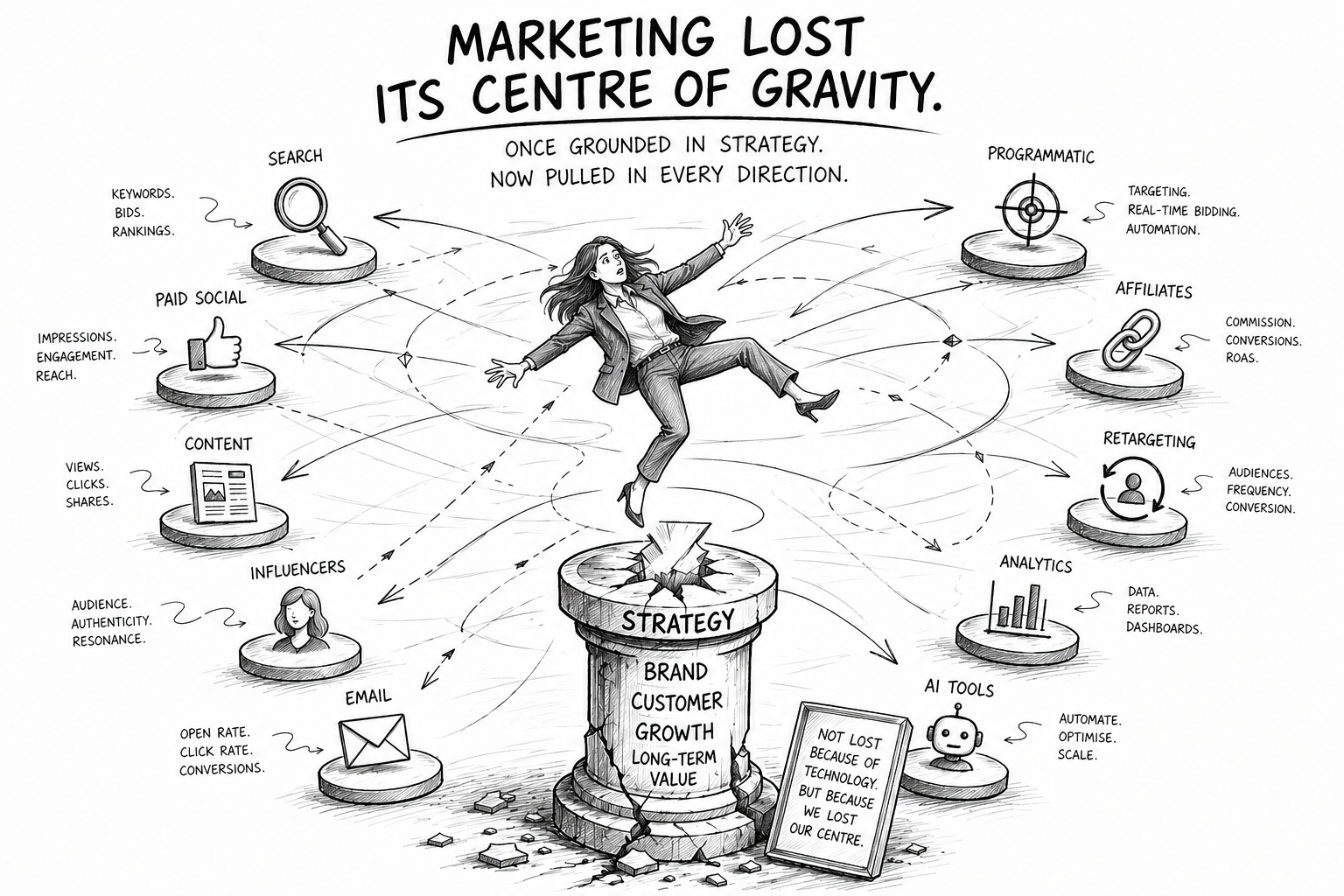
Somewhere along the way, marketing lost its centre of gravity.
It became fragmented, distributed across an expanding ecosystem of specialists, search, social, and programmatic, each optimising their own channel, but rarely accountable for the total outcome. Models were built around conversion and optimisation, often focused on extracting value from existing customers rather than creating new markets, new demand, or new growth.
The consequence is now visible. We have a generation of marketers who can adjust a bid strategy in real time, but struggle to build a brand that commands a premium, holds a position, or creates meaningful differentiation. We confused tactical execution with strategic marketing.
AI does not threaten great marketing. It replaces average execution. The middle layer of marketing, the operators, the optimisers, the channel managers, are the most vulnerable, not because they lack capability, but because they have been trained into roles that technology can now perform faster, cheaper and with greater precision.
Organisations are beginning to ask the fundamental questions. What did all our activity actually build? What is the enduring value of years of optimisation if it hasn’t translated into brand strength, pricing power, or sustained demand?
I’ve said it many times: Performance without positioning is just noise. And efficiency without strategy is a race to the bottom. No amount of paid media can compensate for a weak brand. You cannot execute your way out of a strategic deficit.
This moment is being described by some as a disruption or even a collapse. It is neither. It is a correction. Rebalancing the discipline back toward what marketing should be will drive growth, create demand, and embed the strategic marketing function back into the core of business decision-making.
There will be consequences. Restructures will continue. Some agencies and many roles will not survive. More specifically, the execution-heavy roles that have defined the last decade will increasingly be automated because the systems are capable and more integrated to do their work.
At the same time, the value equation will reset. The advantage will shift to the thinkers, the strategists, the integrators and those who can interrogate both human and AI-generated outputs, applying judgment, context, and commercial acumen, and recognising this moment for what it is: an opportunity.
The marketers who endure are the ones who will look at a campaign, a platform, or a piece of work and say, with clarity and conviction, “That’s wrong and here is why.”
For those who understand how to build strategy, this is not a moment to retreat.
It is a moment to lead.